
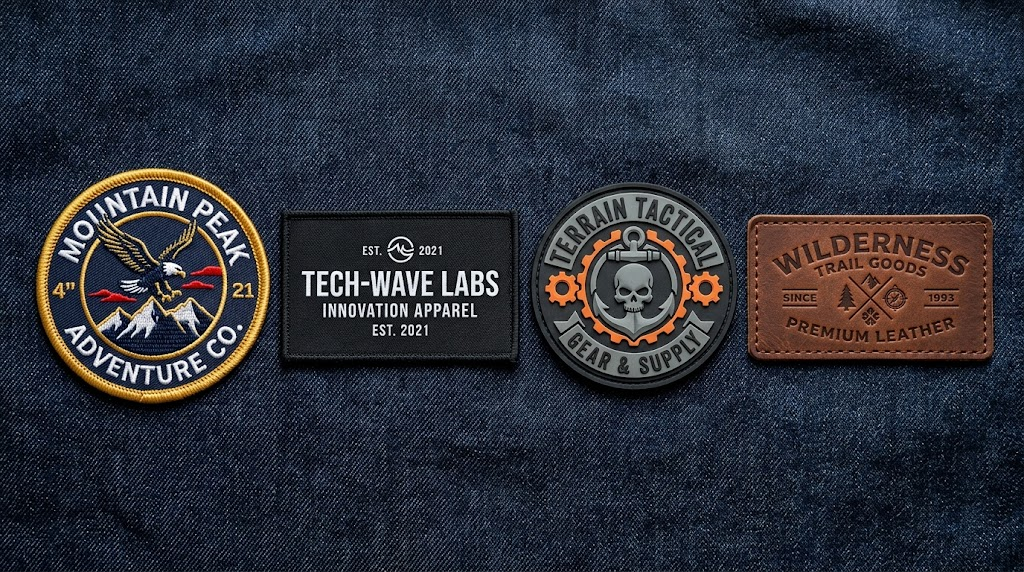
Quick answer: Garment patches are pieces added to clothing for branding, decoration, identification or repair. The right patch depends on your artwork, the garment fabric, the level of detail you need, and how the patch will be attached and used.
A simple logo may look best as an embroidered patch. Small text may be clearer on a woven patch. Detailed artwork may be better suited to a printed patch.
The biggest mistake is choosing a patch type first and checking the design later.
Start with the design and garment. Then choose the patch.
Table of Contents
- What are garment patches used for?
- Which type of garment patch is best?
- What are embroidered patches and when should you choose them?
- When are woven patches better?
- When should you choose printed, chenille, leather or PVC patches?
- What borders, threads and backings should you know about?
- How do you choose the right garment patch?
- What size and placement should you choose?
- How do you attach a garment patch?
- What mistakes should you avoid?
- Which patch is right for your use?
What Are Garment Patches Used For?
Garment patches are used to add identity, information or visual interest to clothing. They can carry a brand logo, name, team badge, job role, decorative design or cover a damaged area.
Common uses include:
- Clothing brand labels and logos
- Workwear and staff uniforms
- School, club and team badges
- Denim jackets and fashion garments
- Sportswear and varsity clothing
- Promotional clothing and merchandise
- Repairing holes or worn areas
The same patch does not work equally well for every purpose. A patch for a fashion hoodie may need a different look and finish from one made for frequently washed workwear.
Which Type of Garment Patch Is Best?
There is no single best garment patch. The best choice is the one that matches your design, garment and purpose.
| Patch Type | Best For | Fine Detail | Texture | Durability |
|---|---|---|---|---|
| Embroidered | Bold logos, uniforms | Medium | Raised | High |
| Woven | Small text, fine lines | Very High | Flat | High |
| Printed | Complex artwork, colour detail | Very High | Smooth | High |
| Chenille | Varsity letters, bold designs | Low–Medium | Thick and soft | High |
| Leather | Premium branding | Medium | Natural | High |
| PVC | Outdoor or rugged use | High | Dimensional | Very High |
Use this table as a starting point—not as a replacement for checking your actual artwork.
What Are Embroidered Garment Patches and When Should You Choose Them?
Embroidered patches are made by stitching thread onto a patch base, often twill, to create a raised and textured finish. Choose them when you want a bold, classic patch look and your design does not rely on extremely tiny details.
They work especially well for:
- Uniform badges
- Bold company logos
- Team emblems
- Jackets and workwear
- Simple shapes and lettering
A key manufacturing choice is thread coverage. A patch with more visible twill can look lighter and more open, while a high-coverage patch has a fuller stitched appearance.
For very small text, thin lines or tightly packed artwork, embroidery may make details merge. In that case, woven construction can be a better choice.
What Are Woven Garment Patches Best For?
Woven patches are best when your design has small text, fine lines or detailed artwork that needs to remain clear. They have a flatter surface because the design is woven into the patch rather than built with raised embroidery stitches.
Choose woven patches for:
- Detailed brand logos
- Small lettering
- Fine borders and lines
- Clothing labels
- Slim or lightweight garments
If your artwork looks crowded when reduced in size, do not automatically make the patch bigger. First ask whether woven construction can show the detail more clearly.
When Should You Choose Printed, Chenille, Leather or PVC Patches?
What Are Printed Garment Patches Best For?
Printed patches are best for artwork with complex colour, very fine visual detail or gradients that embroidery may struggle to reproduce.
Choose printed when the design itself matters more than a raised thread texture.
When Is Chenille the Right Choice?
Chenille patches are best for large, bold letters, numbers and simple varsity-style designs. Their thick, soft texture makes a strong visual statement but is not ideal for tiny text.
When Should You Use Leather Patches?
Leather patches are a good choice when the material itself is part of your brand look. They are commonly used on denim, caps and premium apparel.
When Is PVC a Better Option?
PVC patches are useful when you want a moulded, dimensional and hard-wearing finish. They are often chosen for outdoor, rugged or weather-exposed products.
What Borders, Threads and Backings Should You Know About?
These details can change both the appearance and function of a garment patch.
What Is a Merrowed Border?
A merrowed border is a thick, wrapped thread edge that gives a patch its classic raised outline. It works best on simple shapes such as circles, rectangles and shields.
What Is a Hot-Cut or Laser-Cut Border?
Hot-cut and laser-cut edges create a flatter finish and allow more freedom for detailed or unusual patch shapes. These options can be useful when a traditional wrapped border cannot follow the design accurately.
What Thread Should You Choose?
Polyester and rayon are two common embroidery thread options, but the best choice depends on the required appearance and performance. Ask your manufacturer to recommend the right thread for the garment’s use, washing needs and design.
What Is Twill Backing?
Twill is a firm woven base material commonly used for embroidered patches. It provides a stable surface that helps support the stitches and shape of the patch.
How Do You Choose the Right Garment Patch? Follow These 5 Steps
1. Check Your Smallest Detail
Find the smallest text, line or shape in your artwork first. That detail often decides which patch type will work best.
2. Think About the Garment Fabric
Heavy denim, lightweight cotton and stretchy performance fabrics do not behave the same way. Consider the fabric weight, flexibility and expected washing before choosing the patch and attachment method.
3. Choose the Look You Want
Do you want the patch to look:
- Raised and textured? → Embroidered
- Flat and highly detailed? → Woven
- Visually complex and colourful? → Printed
- Bold and varsity-inspired? → Chenille
- Premium and natural? → Leather
- Rugged and dimensional? → PVC
4. Decide How It Will Be Attached
Backing and patch type are not the same thing. An embroidered or woven patch, for example, may be supplied with a sew-on or heat-activated backing depending on the product and application.
5. Get the Artwork Reviewed Before Production
Do not judge embroidery only from a screen image. Ask for a digital proof or production artwork review before placing the full order.
What Size and Placement Should You Choose?
The best patch size depends on available space, design complexity, text and viewing distance.
A simple chest logo can work smaller than a detailed jacket-back design. More detail usually needs more space.
Before ordering, make a paper version at the actual size and place it on the garment. This simple test can reveal whether the patch looks too large, too small or out of proportion.
How Do You Attach a Garment Patch?
Garment patches can be sewn on, heat-applied or supplied with other backing systems. The right method depends on the patch and garment fabric.
For heat application, manufacturers may specify settings such as temperature, pressure and dwell time—the amount of time heat and pressure are applied. Follow the instructions for your specific patch and garment rather than using one setting for every material. Heat sealing can be affected by the patch construction, border style and fabric.
What Mistakes Should You Avoid When Ordering Garment Patches?
Choosing a Patch Before Checking the Artwork
A beautiful patch type can still be wrong for your logo.
Making Text Too Small
If the wording is important, give it enough space or choose a construction method that handles fine detail better.
Ignoring the Border
The border affects the final shape, thickness and overall look.
Treating “Iron-On” as a Patch Type
Iron-on usually describes the attachment backing, not whether the patch itself is embroidered or woven.
Skipping Proof Approval
A small correction before production is much easier than discovering a problem after the patches are made.
Which Garment Patch Is Right for You?
For a Clothing Brand
Choose based on your brand style and logo detail. A bold logo may suit embroidery, while a detailed logo with small text may suit woven or printed construction.
For Workwear or Uniforms
Prioritise clear identification, durability and a secure attachment method.
For Fashion Designers
Start with the visual effect you want, then check whether the material, border and construction support that look.
For Bulk Buyers
Focus on consistency. Confirm the approved artwork, patch size, border, backing and application method before full production.
For Clothing Repairs
Choose a patch that suits the damaged area and does not make the garment unnecessarily stiff or bulky.
Frequently Asked Questions About Garment Patches
What are garment patches?
Garment patches are pieces attached to clothing for branding, decoration, identification or repair. They can be embroidered, woven, printed, chenille, leather, PVC or made from other materials.
Which garment patch is best for small text?
Woven patches are usually the better choice for small text and fine lines because they can show finer detail with a flatter construction.
Are embroidered patches better than woven patches?
No—neither is always better. Embroidered patches are better for a raised, textured look, while woven patches are generally better for fine detail and small lettering.
What is the most durable type of garment patch?
Durability depends on the patch material, border, backing, attachment method and how the garment is used. For demanding conditions, choose the patch type and attachment method based on washing, friction and environmental exposure rather than relying on one universal “most durable” option.
Can garment patches be used to repair clothes?
Yes. Garment patches can cover holes and worn areas while also adding a decorative or branded look.
Can you iron on a garment patch?
Yes, if the patch is made with a suitable heat-activated backing and the garment fabric can safely handle the required application process. Always follow the manufacturer’s instructions for that specific patch.
What should I check before ordering custom garment patches?
Check your artwork, smallest details, patch size, border, backing, garment fabric and attachment method before approving production.
Final Thoughts
The best garment patch is not simply the most popular one.
It is the one that shows your design clearly, suits the garment, fits the intended use and can be attached properly.
Before ordering, make one decision at a time: design first, patch construction second, then border, backing, size and attachment method. That approach reduces guesswork and helps you get a patch that looks right on the finished garment—not just in a digital mock-up.