
Quick answer:
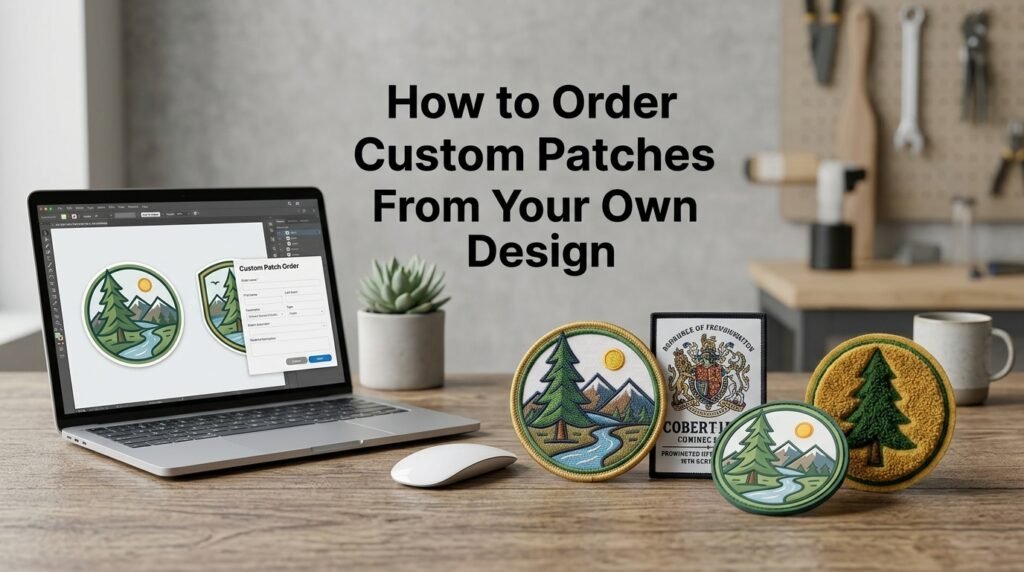
Custom patches are personalized fabric, woven, PVC, chenille or leather badges made from your own artwork, logo or design and attached to clothing, uniforms, bags or other items.
Turning your own artwork into a custom patch is easier when you know what decisions need to be made before production starts. Your design, patch type, size and backing all affect how the finished patch looks and how it can be used.
This guide explains the process step by step.
Key Takeaway
- Start with a clear version of your artwork or logo.
- Choose the patch type based on your design detail and intended use.
- Select a backing that suits how and where the patch will be attached.
- Review your design proof carefully before approving production.
Step 1: Prepare Your Design File

Start with the clearest version of your artwork you have.
Vector files such as AI, EPS and SVG are ideal because they can be resized without losing quality. However, a high-resolution PNG or JPEG can also work well for many custom patch designs.
Before sending your artwork, check for very small details, thin lines and tiny text. These elements may not translate clearly into embroidery.
Simple shapes, clear outlines and strong colour contrast usually produce a cleaner result.
If your design has an unusual shape, a transparent background can also help show the exact outline of the patch.
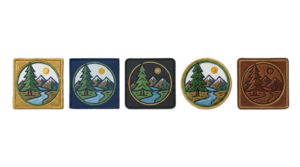
Step 2: Choose the Right Patch Type
The best patch type depends on your design and where you plan to use it.
| Patch Type | Look & Feel | Best For | Relative Cost |
|---|---|---|---|
| Embroidered | Raised, textured thread finish | Logos, uniforms and bold designs | £ |
| Woven | Flat and smooth with fine detail | Small text and intricate artwork | £ |
| PVC / Rubber | Flexible, waterproof and 3D | Outdoor gear and durable applications | ££ |
| Chenille | Soft, thick and textured | Varsity and letterman-style designs | £££ |
| Leather | Premium and distinctive | Branding, hats and accessories | £££ |
Embroidered patches are a popular choice for logos and bold artwork because of their classic textured appearance.
Woven patches are often better suited to designs with fine lines or small lettering.
PVC patches work well when durability and water resistance are important, while chenille and leather offer a more distinctive finish for specific styles and applications.
Step 3: Select Your Patch Backing
The backing you choose determines how your patch will be attached.
Iron-On Backing
Iron-on patches use a heat-activated adhesive backing. They are convenient for garments and other suitable fabrics where sewing is not preferred.
Sew-On Backing
Sew-on patches are attached using thread around the edge. This option is commonly chosen when a secure, long-lasting attachment is required.
Hook and Loop Backing
Hook and loop, often known as Velcro, allows patches to be removed and replaced. This makes it useful for uniforms, bags and other items where patches may need to be swapped.
Combination Backing
Some patches can be attached using heat first and then sewn around the edges for additional security.
Think about how the patch will actually be used before choosing your backing. A backing that works well for a jacket may not be the best option for a bag, uniform or technical fabric.
Step 4: Choose the Right Size and Quantity
Before requesting a quote, decide how large you want the finished patch to be.
The size should suit both your design and the item where the patch will be placed. A highly detailed design may need a larger patch size so that important details remain clear.
You should also decide how many patches you need.
Small orders can have a higher cost per patch because production setup is spread across fewer pieces. Larger quantities can reduce the cost per unit.
Step 5: Upload Your Artwork and Request a Quote
Once you know your patch type, backing, size and quantity, you can submit your design to a custom patch supplier.
The ordering process usually involves:
- Uploading or sending your artwork.
- Confirming the patch size and quantity.
- Choosing the patch type and backing.
- Reviewing a design proof or mock-up.
- Approving the final design before production begins.
Take time to check the proof carefully.
Look at the spelling, colours, shape, dimensions and placement of every design element. Once production begins, making changes may not be possible.
For larger orders, you may also want to ask whether a physical sample is available.
How Long Does It Take to Order Custom Patches?
Production and delivery times vary depending on the patch type, design complexity, quantity and supplier.
A simple order may be completed faster than a large order with complex artwork or multiple design changes.
If you need patches for an event, product launch, team or uniform, it is best to place your order early and confirm the expected production and delivery schedule before approving the order.
How Much Do Custom Patches Cost?
There is no single price for custom patches because several factors affect the final cost.
These include:
- Patch size
- Patch type
- Quantity
- Number of colours
- Design complexity
- Stitch density
- Backing type
- Special shapes or finishes
In general, ordering a larger quantity can reduce the price per patch because setup and production costs are distributed across the full order.
Always check what is included in your quote. Some suppliers may charge separately for design preparation, digitising, backing options or samples.
Can You Design Your Own Custom Patch?
Yes. You can create your own patch design and provide the artwork to a manufacturer.
You do not always need professional design software. A clear image of your logo or artwork may be enough for the supplier to prepare a production-ready design.
However, if your artwork contains fine details, gradients or very small text, the design may need to be adjusted depending on the patch type you choose.
What File Format Should You Use?
Vector formats such as AI, EPS and SVG are generally useful because they retain quality when resized.
High-resolution PNG and JPEG files can also be suitable, especially when the original artwork is clear.
If you are unsure whether your file is suitable, send the best version of your design available and ask for feedback before production.
What Happens If Your Design Is Too Detailed?
Not every design translates perfectly into an embroidered patch.
Very small text, thin lines and complex artwork can become difficult to reproduce with thread.
In these cases, a woven patch may be a better option because it can handle finer detail. Simplifying certain parts of the design may also improve the final result.
The important thing is to review the proof before approving production.
Can You Order Just One Custom Patch?
Some custom patch suppliers accept small orders or individual samples, while others have minimum order requirements.
If you only need one patch to test your design, check the supplier’s minimum quantity before placing your order.
A sample can be useful when you want to see the size, colors and texture of the finished patch before ordering a larger quantity.
Which Patch Backing Should You Choose?
Choose your backing based on how permanent or removable you need the patch to be.
- Choose iron-on for a convenient heat-applied option.
- Choose sew-on when you want to stitch the patch securely in place.
- Choose hook and loop when the patch needs to be removable.
- Consider a combination option when you want the convenience of positioning the patch with heat before securing it with stitching.
Final Thoughts
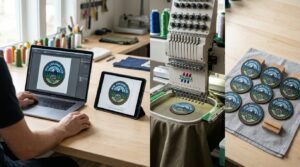
Ordering custom patches from your own design starts with understanding how your artwork will translate into the finished product.
Prepare a clear design, choose a patch type that suits the level of detail, select the right backing and carefully review your proof before production begins.
Whether you are ordering patches for a business, clothing brand, club, school, event or personal project, taking a little time to make these decisions first can help you get a finished patch that looks closer to the design you originally had in mind.
Knowledge Blog Suggestions
Click Here : How to Choose the Best Custom Patch for Your Jacket
FAQs
Can I create custom patches from my own design?
Yes, you can submit your own artwork or logo and have it turned into a custom patch.
What file format is best for custom patch designs?
Vector files such as AI, EPS and SVG are ideal, but high-quality PNG and JPEG files can also work.
Which patch type is best for detailed designs?
Woven patches are often better for small text and fine details, while embroidered patches work well for bold designs.
Can I order custom patches in small quantities?
Yes, many custom patch suppliers offer small orders, although availability and pricing may vary.
How do I choose the right backing for my patch?
Choose iron-on for easy application, sew-on for a secure attachment, or Velcro backing if you want the patch to be removable.