
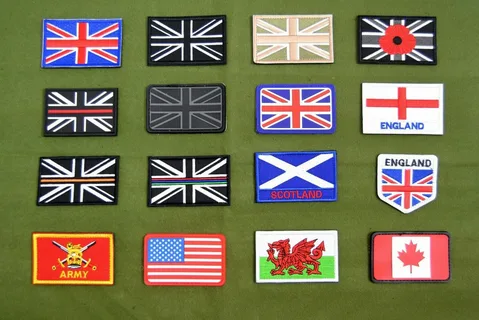
Military patches are far more than decorative flourishes stitched onto a uniform. For the British Armed Forces, they represent identity, honour, unit cohesion, and a living record of military history. From the muddy trenches of the Second World War to today’s highly specialised operations, the evolution of British military patches tells the story of an army that has continuously adapted while fiercely protecting its traditions.
The Roots of British Military Insignia
Long before the mass-produced embroidered patch became standard, the British Army identified its soldiers through coloured facings on tunics, regimental cap badges, and shoulder titles. These traditions stretch back centuries, but it was the industrial scale of the World Wars that transformed military insignia into the patch culture we recognise today.
By the time Britain entered the First World War, regiments already wore distinctive cloth shoulder titles — simple woven strips bearing a unit’s name or abbreviation. These were functional, not decorative, designed to help officers identify men in the chaos of battle. The seeds of the modern patch had been planted.
World War Two: The Golden Age of British Military Patches
The Second World War was the defining moment for British military patches. With millions of men and women mobilised across multiple theatres — North Africa, Italy, Northwest Europe, Burma, and beyond — the need for rapid visual identification became operationally critical. Formation signs, as the British Army called them, flourished.
Every major formation developed its own distinctive emblem. The Desert Rats of the 7th Armoured Division adopted their now-legendary jerboa — a small desert rodent — as their emblem, a symbol of speed and resilience that endures to this day. The 51st Highland Division wore a distinctive “HD” monogram that became feared by German forces across North Africa and Europe. The 1st Airborne Division, whose tragic heroism at Arnhem became immortalised in history, wore the iconic Bellerophon riding Pegasus — a winged horse that has since become one of the most recognised symbols in British military heritage.
These patches were typically worn on the upper sleeve and served a dual purpose: building morale and esprit de corps within units, while also allowing commanders and allies to identify formations quickly on the battlefield. The psychological function should not be underestimated — soldiers fought harder when they fought as part of something with a name, a symbol, and a reputation.
Colours were chosen with care. The bold combination of black, red, and gold featured prominently across many divisional signs, echoing traditional heraldic conventions. Animals were popular — the bull of the 11th Armoured Division, the polar bear of the 49th Infantry Division — reflecting a British fondness for totemic imagery drawn from nature and mythology.
Post-War Evolution: Maintaining Tradition Through Change
The decades following World War Two brought dramatic structural changes to the British Armed Forces. Conscription ended in 1960, the empire dissolved, and regiments were amalgamated under successive defence reviews. Yet the patch tradition survived, adapting to each new reality.
During the Cold War, British forces serving with NATO adopted standardised patches alongside their traditional formation signs, reflecting the new era of multinational alliance warfare. Service in Cyprus, Northern Ireland, the Falkland Islands, and the Gulf all produced their own distinctive insignia — some officially sanctioned, others semi-official “theatre patches” that soldiers wore with enormous pride.
The Falklands War of 1982 is particularly notable. Though fought at extraordinary speed with relatively little time for patch production, veterans of the campaign developed a strong retrospective patch culture, with unit associations later producing commemorative insignia that became highly sought after by collectors and veterans alike.
Special Forces and the Culture of Subdued Insignia
As British military doctrine evolved through the 1980s and 1990s, a new patch aesthetic emerged alongside the rise of special operations forces. The Special Air Service, Special Boat Service, and their support elements developed a culture of subdued insignia — patches rendered in muted tones of olive, sand, and grey rather than vibrant colours, designed to reduce visibility in combat environments.
This shift influenced the broader British Army. Modern operational patches often appear in low-visibility formats, with the same cap badge or formation sign rendered in tan-on-tan or black-on-black embroidery. The message is the same; only the volume has been turned down.
Modern British Military Patches: Continuity and Innovation
Today’s British Armed Forces wear a layered system of insignia. The regimental cap badge remains the cornerstone of identity — a tradition stretching back generations. Alongside it, soldiers wear rank slides, qualification badges, and where appropriate, formation patches denoting their current operational assignment.
Modern patches reflect both heritage and contemporary capability. Cyber units, information operations specialists, and joint task force elements have all developed their own insignia in recent years, extending a tradition that began in the fields of Normandy to entirely new domains of warfare.
The Velcro-backed patch — known in military circles as a “morale patch” — has also gained unofficial prominence. Traded between allied forces, earned through exercises and deployments, and worn on kit bags and plate carriers, morale patches exist in a fascinating grey space between official insignia and personal expression. They are the wartime swapped shoulder title made modern.
A Living Tradition
What makes British military patches remarkable is their continuity. The Desert Rats still wear their jerboa. Airborne forces still wear Pegasus. The cap badge of a regiment founded in the eighteenth century still rides above a modern soldier’s beret in the twenty-first.
In a military culture that prizes regiment, tradition, and institutional memory above almost all else, the patch is never merely decorative. It is a covenant — between a soldier and their unit, between the present generation and all those who served before them.